- VMAP Home
- About VMAP
- Vog Forecast Discussion
- Vog Model
- Vog and Health
- Links
- Model Performance
- Disclaimer
- Weather Server
- Contact Us



Current Conditions
To view the Halema`uma`u webcam, click here.
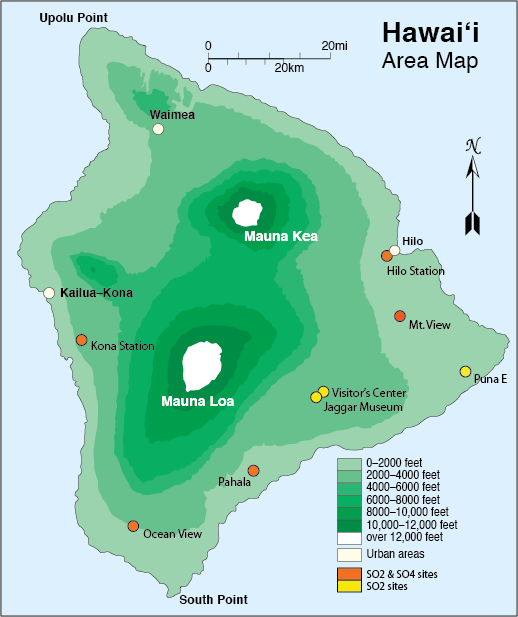
The observed conditions at the stations listed in the table below are actual conditions measured by Hawaii State Department of Health and National Park Service. These values are not modeled predictions. In the case of the aerosol measurements, PM2.5 (Particulate Matter of size 2.5 µm or less) observed values include SO4 as well as all other aerosols smaller than 2.5 microns. PM2.5 may include dust, salts, and other pollutants. More information and observations can be found on the Hawaii State Department of Health website here.
 |
Disclaimer: The above data show the last measurement values received only, as available from the individual data providers. Be certain to check timestamps. The University of Hawai'i and the VMAP program do not operate these sensors.
For an explanation of the SO2 color scale, click here. For a detailed explanation of the PM2.5 Aerosol color scheme, click here. Trends denoted in the table above are relative to the preceeding hour.
|
|||||||||||||||||||||||||||||||||||||||||||||||||||||||||||||||||||||||||||||||||